![Pop [Punk] Psychology](https://substackcdn.com/image/fetch/$s_!KtCR!,w_120,h_120,c_fill,f_webp,q_auto:good,fl_progressive:steep/https%3A%2F%2Fsubstack-post-media.s3.amazonaws.com%2Fpublic%2Fimages%2F5743faea-07fe-4a5f-9402-3e61474152fa_913x913.png)
Stop Powering Through: Start Escaping
Detachment Breaks with Boys Like Girls

The Concept: Detachment Breaks
The Track: “The Great Escape” by Boys Like Girls
The Story: From the Concert to the Office
I recently caught Boys Like Girls live in Tampa with a couple of professor friends.** During their platinum-certified hit “The Great Escape,” the energy was undeniable. There was something about a room full of people screaming “Throw it away, forget yesterday” that felt like a collective exhale. In that moment, nobody was thinking about their unread Slack messages or the project deadline looming on Monday. It was a collective, high-decibel disconnection from the outside world.
**Yes, you read that correctly…professors at a rock concert!
But then, the next workday hits. You’re back at your desk with 14 browser tabs open and about 50 “mental tabs” running in the background. You’re trying to prep for a meeting while still ruminating on an email that went sideways yesterday. Physically, you are at your desk; mentally, you are everywhere and nowhere. You feel the “burn” — not the high-octane energy of a concert, but the slow singe of burnout. You realize you aren’t actually solving problems anymore; you’re just moving digital piles of sand.
This is the moment where you need to stop trying to “power through” and instead, stage your own private and temporary disconnection.
The Concept: The Great Escape of the Mind
In business psychology, Detachment Breaks are intentional periods where we psychologically disengage from work demands. It’s not just “not working”; it’s the active process of stopping the work-related thoughts that drain our battery.
The lyrics from “The Great Escape” capture the mechanics of this recovery:
“Throw it away, forget yesterday”: This is the “Cognitive Offloading” Phase. To find focus, we have to “throw away” the distractions — the notifications, the lingering guilt over an unfinished task, and the “yesterday” of previous stressors. By temporarily putting aside the immediate past, we clear the cache of our working memory.
“We’ll make the great escape”: This is the Restoration Phase. An escape isn’t a retreat; it’s a strategic move to a “safe zone” where your nervous system can reset. This allows for enhanced creativity, because a mind that isn’t under siege is a mind that can innovate.
A Sidenote: We are talking about Psychological Detachment, not Emotional Detachment. While the latter is about distancing yourself from people or relationships to avoid feeling, the former is a healthy recovery tool used to build resilience and prevent professional exhaustion.
The Action Point: The "Off-Grid" Fifteen
To build resilience, you don’t need a three-week vacation (though that is not a bad idea); you need a consistent Off-Grid Fifteen.
The Move: Once or twice each workday, set a timer for 15 minutes. Put your phone in a drawer, close your laptop, and physically move to a different space — even if it’s just a different chair or a quick walk outside. Bonus points if your escape can involve even the slightest of physical activity (like a walk).
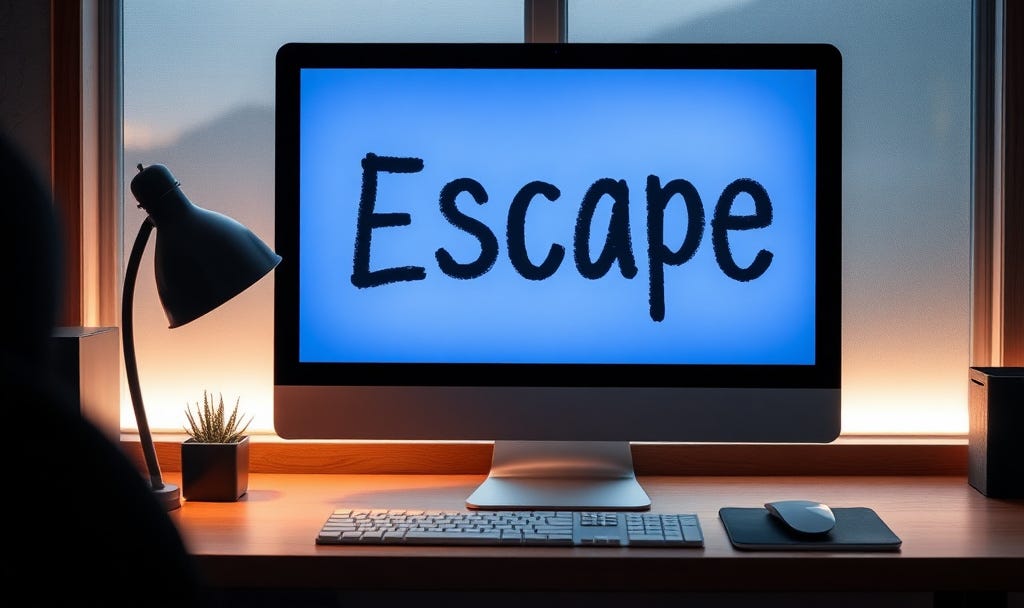
During this time, your only job is to “forget yesterday.” Don’t plan, don’t troubleshoot, and don’t “check in.” When the timer goes off, you’ll find that The Great Escape gave your brain the system reboot it needed to return to the task with actual clarity rather than just more caffeine (but if you do desire more caffeine, give this cold brew a try!).
It is easy to feel like stepping away is a loss of valuable work time, but the psychology of resilience is counterintuitive. While it might look like you are losing fifteen minutes of "output," making "The Great Escape" ensures the hours that follow are actually productive and efficient, rather than just busy.